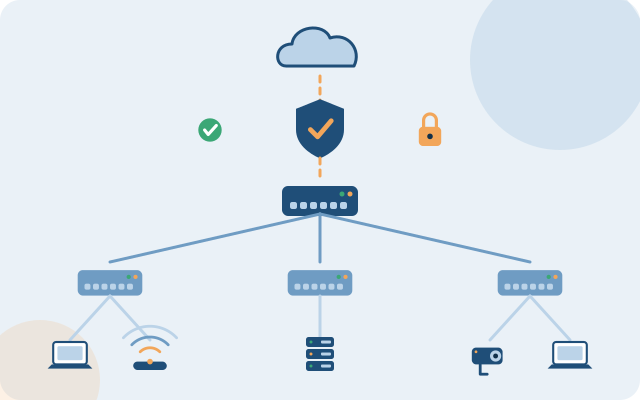
Technology by category is only a component. The real solution lies in how they are connected into one model that fits your size and operating characteristics.
3 linked parts of one technology solution
Reference model
Single office, with ISP / firewall / core switch redundancy
This is the most basic of the 9 models COREIT applies. The other models (multi-floor, multi-branch, data center...) extend from this foundation.
— main connection flow ┄┄ redundant link (HA/failover)
All 9 models, with how each is organized (backbone axis or peer network), its core technology and its benefits, are on the page Backbone & management.
Choosing the right architecture model
Start from who you are, not from the technology
COREIT first analyzes the customer's operating characteristics (size, number of locations, acceptable risk level) before proposing a suitable architecture model. The table below is a quick starting point; the reasons for each choice and how each model is implemented are in the cards below.
Multi-floor / multi-building, combined with a Ring Backbone if fiber cost needs optimizing
Business with 2 or more offices/branches, retail or service chain
Multi-branch
Large business, or one with its own compliance/data-storage requirements
Data center (self-operated or via a partner IDC)
Small or new business already fully on SaaS/cloud, limited budget
Cloud-first / no dedicated server room
Technology/outsourcing company, staff working in shifts or remotely
Remote work / Hybrid
Business with high security requirements: finance, sensitive data, foreign-partner NDAs
Fully integrated security (Fabric)
Hotels, apartments, coworking spaces and multi-tenant complexes
High-density wireless / many shared areas
Single office
Why this modelA small business with 1 office and under 50-100 users that needs fast deployment on an optimized budget, and does not yet need a complex architecture at this size
What COREIT implements1 firewall + 1 core switch configured as HA from the start, to avoid a complete outage when one device fails; configured and monitored through a single interface
ExampleAn office of about 30 users: the entire infrastructure is installed and put into operation in 3-4 days, with no in-house IT team needed to watch it daily
Multi-floor / multi-building within one campus
Why this modelToà văn phòng nhiều tầng, khách sạn, chung cư, khu phức hợp — 1 chủ quản lý nhưng cần cô lập sự cố theo từng khu vực, tránh ảnh hưởng dây chuyền
What COREIT implementsPlace the core switches in an HA pair at the central floor/building, run fiber between floors/buildings when copper's 100 m limit is exceeded, and give each floor/building its own switch
ExampleA 5-floor building with over 150 users: adding a 6th floor later needs only one more fiber run and one floor switch, with no redesign of the whole system
Ring Backbone
Why this modelMany floors/buildings/areas needing a seamless backbone, while optimizing fiber cost compared with a fully redundant star topology
What COREIT implementsConnect the switches of the buildings/floors in a closed fiber ring, each switch needing only 2 uplinks to its neighbors; one central firewall/controller manages the whole ring
ExampleMulti-building complex: connect each building's switches in a fiber ring, with one central firewall managing everything, saving many separate cable runs compared with a star topology
Multi-branch
Why this model2 or more offices/branches, retail or service chain: needs centralized operations and monitoring from headquarters despite many locations
What COREIT implementsEach branch has one edge device connecting by SD-WAN/VPN to headquarters, with a backup WAN line; security policies are pushed to all sites at once from one place
ExampleA chain of 5 retail stores: when a 6th store opens, only one edge device needs to be installed at the new site and linked to headquarters, with no reconfiguration of existing stores
With a data center
Why this modelA large business, or one with its own compliance/data-storage requirements, needing full control of infrastructure and data
What COREIT implementsFrom 2-3 racks upward, use a Spine-Leaf architecture for even bandwidth between racks; meet Tier III/IV with UPS + generator N+1/2N; can be deployed through a partner IDC if you prefer not to run your own server room
ExampleA business with 2-3 server racks: host them at a partner IDC instead of building its own server room, and COREIT surveys capacity, connects and monitors operations on your behalf
Cloud-first / no dedicated server room
Why this modelA small or new business already fully on SaaS/cloud, with a limited initial budget and no wish to pay for a server room
What COREIT implementsOnly a firewall + switch + wireless at the office, connected straight to the cloud via SD-WAN/VPN; 2 high-speed Internet lines from independent carriers replace server-room redundancy
ExampleA business of 15-20 users with all applications in the cloud: only a firewall + switch + wireless at the office, and adding users needs no change to the network infrastructure
Remote work / Hybrid
Why this modelA technology/outsourcing company, with staff working in shifts or remotely and no limit on where staff work
What COREIT implementsConfigure client-to-site VPN or a ZTNA agent on each employee's device, one account per person limited to project permissions; multiple VPN/ZTNA gateways at once, with load balancing between gateways
ExampleAn outsourcing company with staff working in shifts from many places: each person has their own VPN/ZTNA account limited to project permissions, with real-time session monitoring
Fully integrated security (Fabric)
Why this modelA business with high security requirements (finance, sensitive customer data, NDAs with foreign partners) needing fast detection and response across the whole system, not just individual layers
What COREIT implementsIntegrate API/telemetry between firewall, switch, AP and endpoint into one common management platform from the design stage; an anomaly detected at any layer automatically isolates the related device or network segment
ExampleThe firewall detects a suspicious IP address and automatically isolates the related switch port or endpoint account within seconds, with no technician working on each device by hand
High-density wireless / many shared areas
Why this modelHotels, apartments, coworking spaces and multi-tenant complexes: many simultaneous users who need a stable experience and faults isolated by zone
What COREIT implementsSurvey real device density (not just floor area) to place the right number of access points, with separate network zones per area/room and smooth roaming between APs
ExampleHotels and apartments: one connection account per room, with access points placed by measured device density from the survey, not by room area
Not sure which model fits?
Book a survey. COREIT analyzes your operating characteristics and proposes a suitable architecture model within a few working days.